Showing posts with label aoi bungaku. Show all posts

Friday, January 15, 2010

Final Thoughts: Aoi Bungaku

So sorry for this post being late. I had to do some real world stuff. Anyhoo, this is it for Aoi Bungaku. I'll be replacing this slot with whatever interesting series I'll be watching this season. Next week will be my first impressions of some of the recent series I've watched so far.
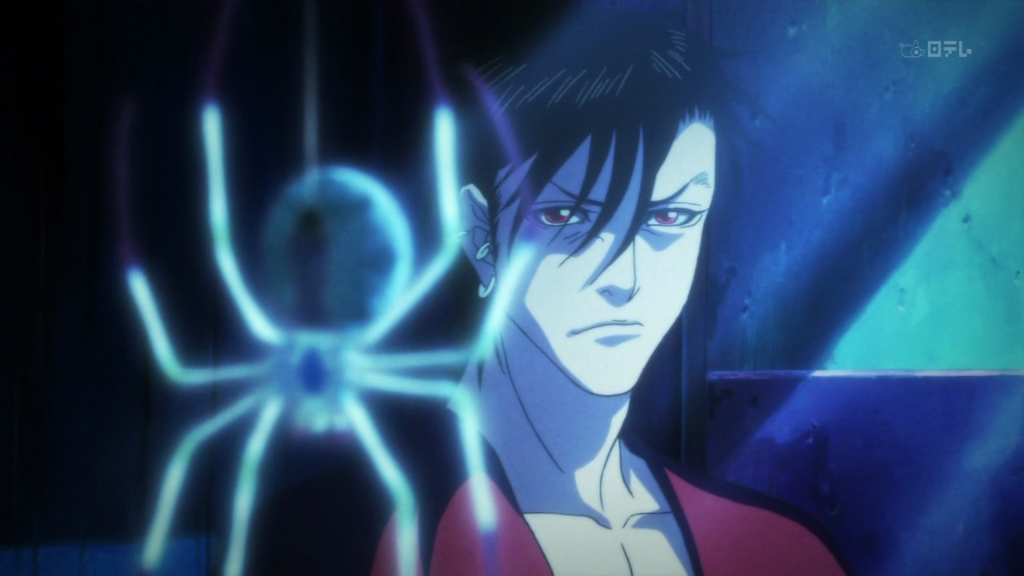
Spider's Thread
More Screencaps from Aoi Bungaku 11: Spider's Thread

Kandata, a criminal who does not think twice about murder, commits the greatest crime of all by disturbing the country-wide celebration held in honor of the king. In his wrath, the king orders his men to bring Kandata to him for his well-deserved punishment. At first, ruthless Kandata has no trouble eluding his pursuers. However, danger comes to him from the most unlikely of persons: a kid whose mother he once thoughtlessly killed for a bite of food. Now a wounded Kandata takes shelter under the eaves of a house and finds -- of all things -- a spider, and for the first time, he does not harm a creature simply because he could, saying instead that no matter how small a life, it was still worth living. The next day, Kandata is seized by the king's troops and the king lays down upon him the death penalty. Up to the end, Kandata does not display remorse for his sins. He wakes up in a strange place where people are constantly trying to kill him, but when he fights back, it is always himself that he ends up murdering. This happens over and over until Kandata can take no more and cries out for help. He sees then a strange light coming from above and a faint, shiny string flowing down. It's a spider's thread! Kandata tests its strength, then starts climbing. When he is almost the top, he realizes that others are trying to climb the thread as well. Fearing the thread would break, Kandata kicks at them, screaming that the spider's thread belongs to him. Then all of a sudden, the thread gives way as the spider waiting for him above abandons Kandata to the bottom pits of hell.
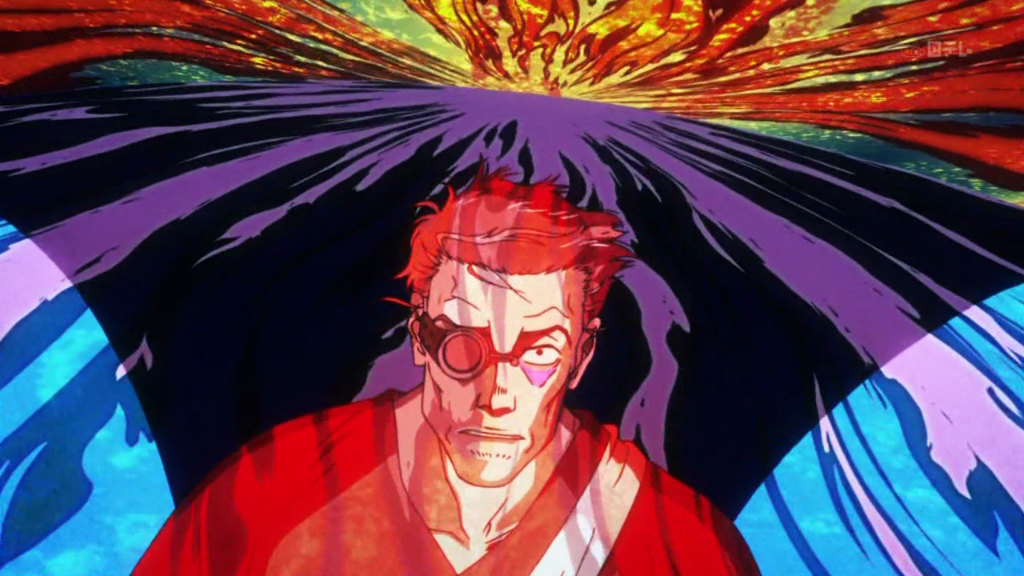

Hell's Screen
More Screencaps from Aoi Bungaku 12: Hell's Screen

Yoshihide, royal painter, has just finished his latest masterpiece: a protrait of the king. The king is very pleased and celebrates this accomplishment by hosting a boat party. An accident occurs but instead of helping the survivors, the king orders his guards to kill the upstarts who dare to interrupt his party. Yoshihide and his daughter, Mitsuki, see this with their own eyes and are horrified. Then, as though nothing has happened, the king turns to Yoshihide and says that he wants him to paint another great masterpiece. That evening, Yoshihide reveals to Mitsuki his misgivings about painting the king's idea of beauty when he does not understand it himself. The next day, the king summons Yoshihide and shows him the inside of a mausoleum, which is intended to be his final resting place. He wants Yoshihide to paint his country and his people on the inner walls so that even in death he may continue to rule the country. Yoshihide accepts the commission without protest. One night, the whole city is in chaos due to a plague affecting many people. The king's army, armed with torches, is dispatched, not to help the suffering people but to burn them alive. Yoshihide witnesses the event and is unable to stop himself from drawing what he sees. These drawings become the study for his painting on the king's tomb. When the king sees the final work, he is naturally angry. Instead of beauty, Yoshihide has painted a hell's screen. But Yoshihide is not finished. In the middle of the tomb, he wants to paint a person screaming in pain as his body is engulfed in flames. So he asks the king to show it to him so that he may be able to paint it. The king, still angry over Yoshihide's "insult," gives Yoshihide what he wants, adding his own sadistic touch: he burns Mitsuki at the stake. Yoshihide realizes the king's trick and can only watch as Mitsuki is engulfed in flames, just like in his vision for his painting. However, the king miscalculates as the flames spread, catching his clothes and burning him as well, while Yoshihide just watches, having resigned himself to paint what he sees. The tomb is finally finished and among the principal figures that Yoshihide painted is that of the king burning in hell alongside the criminal Kandata. And at the center of it all is Mitsuki's face amid flames and lying next to it is the dead body of Yoshihide.


FINAL THOUGHTS:

What an appropriate end to a dark, mangly series. I'm not sure if I like the story of these last two episodes compared to the others but they are quite interesting, being more of straightforward fantasy tales than anything else. They also take the moralizing tone of Run, Melos! to a different level -- kid-level, in fact. Apparently, Spider's Thread is a kid's story. No small wonder there. Although a story with that much blood and violence involved is something only Japan can consider as "child-friendly." fufufufufu ~

By contrast, Hell's Screen is clearly for adults. But again, the author takes such a clear-cut approach to the storyline that it might as well be considered "for kids" as well. According to the episode introductions, Hell's Screen is the author's attempt at writing in the style of his contemporaries -- that is, writing in the first person point of view and basing the story on his own personal experiences. When it first came out, it wasn't received very well and the author committed suicide later on. Oh, Japan -_-

These two stories being very clear, as I said, I don't think I need to elaborate on the whole thing any further. The hidden meanings aren't hidden and the lessons are stuff you've probably learned (or should've learned) a long time ago.

That said, yes, Aoi Bungaku has been a good series. Most of the story arcs are interesting and I can't find fault with the art and animation at all. Madhouse does it again. But I think I will best remember Aoi Bungaku for opening my eyes to Japan's literature gems, something which I think has been the goal all along.

Now to look for English translation copies of these books. ^_^


Don't forget: next week, on the same timeslot, first impressions for Sora no Woto, Dance in the Vampire Bund, Durarara! and Ookami Kakushi.

Friday, January 8, 2010

Aoi Bungaku 9-10: Of greeks and yaoi

Sorry this took a long time. I intended to post this last year but the episodes couldn't be out any faster and by the time they went out, I had to be away. But anyhoo, here's the third to the last story arc in the consistently brilliant Aoi Bungaku.
Run, Melos!
Chapter 1
More Screencaps from Aoi Bungaku 09

Takada is a struggling writer commissioned to write a play adapted from a popular Greek legend about Melos who, about to be executed, begs the King to allow him to attend his sister's wedding; the King agrees but only if Selinuntius, Melos' bestfriend, takes his place and be executed if Melos fails to appear before sunset on the third day. Takada accepts the job but later has second thoughts as he realizes that the original story strikes too close to home. He recalls an incident in high school when he and his best friend, Joushima, decided to leave for Tokyo. Takada waited for him at the station but Joushima never showed up. As Takada leaves on board the train, he throws the pocketwatch that Joushima gave him out the window. At that same moment, he sees Joushima standing on the platform but by then it is already too late as the train gains speed. Takada lives on with the bitter knowledge of his bestfriend's betrayal.

Run, Melos!
Chapter 2
More Screencaps from Aoi Bungaku 10

Despite his earlier misgivings, Takada continues to write the play, struggling with his own inner demons and merciless recollections along the way. Melos is finally on his way back to the King but has to go through many obstacles, including a broken bridge and bandits. As Melos falls at the hands of the bandits, Takada loses courage to continue. Then he gets a vision of Joushima, who urges him to finish the story. Takada lets out all his anger but the vision only says that he's waiting. After that, Takada receives a telegram from Joushima's wife, telling him that Joushima is dying from heart disease and has requested to see Takada one last time. Without thinking, Takada rushes out of his house and heads for the station. In the play, Melos wakes up, battered and bruised, and uses the last ounce of his strength to run back to the King. Takada arrives at Joushima's deathbed and to him he pours out all his feelings of being betrayed. When he is finished, Joushima asks him to tell him how the play ended: Sunset. Selinuntius is about to be executed when Melos arrives, smiling in happiness even in the face of certain death. At this, Joushima finally cries, and the two friends are reconciled.


COMMENTS:

Run, Melos! is an adaptation of Damon and Pythias, two legendary Greeks whose unwavering friendship withstands the test of the knife and a cruel tyrant. Apparently, Osamu Dazai (author) got the inspiration for the story when one day he, along with a friend of his, went to a hot springs resort where they soon went over budget. Dazai promises to pay back the extra by writing a quick short story and selling it, while his friend waits. However, Dazai never wrote the story and indeed never showed his face to his friend for a long time. When they finally saw each other, his friend confronted him, prompting Dazai to pose this rhetoric question:

Who has it harder: the one who waits, or the one who makes others wait?

And so Run, Melos! was born.

This is again a liberal take by Madhouse. Instead of just telling the short story straight, the studio opted to intersperse the author's own experience with the play, drawing parallels between the two, so that we end up not with one but two tales in one. Brilliant! Even so, it is still a very simple story that focuses on friendship with a surprisingly happy ending, and in that, it wholly differs from all the other story arcs so far shown in this series. It's kind of hard to reconcile this work with the depressing piece that No Longer Human is. There is some explanation given: Run, Melos! is an earlier work by Dazai, supposedly at a time when he was...happier. At any rate, it's a welcome change of pace.

Nakamura Ryosuke directs and storyboards this arc. He's the guy responsible for Mouryou no Hako and has had a hand in many other outstanding series the likes of Monster, Gunslinger Girl, NANA, and Death Note. But I think in Run, Melos!, he surpasses even himself. In fact, I'd go on to say, that in terms of directorial style, Run, Melos! is a stand-out in the Aoi Bungaku-verse. I can't really put it into words; you'll have to see the series for yourself.

Character designs are also good. Konomi Takeshi of Prince of Tennis fame came up with the original designs for the characters of Run, Melos! I have to say, the design is one of the best-looking in the series, next only to Kubo Tite's more eclectic rendering in episodes 5-6.

This is the third to the last story arc in the Aoi Bungaku series. I can't believe it's drawing to a close. This series is particularly close to my heart because it opened my eyes to many literature gems in Japanese culture. Quick! Where can I find English translations of these books?

^.^

Tuesday, December 15, 2009

2009 Year-Ender Anime Rankings

This is my last post for 2009. I'm spending the holidays with family in the province and don't expect to log on to the Internet for the period. I'll come back next year and hopefully pick up where I left off. Before that, let me offer you my list of the best anime (IMHO) that 2009 has to offer. (NOTE: included are titles from the Winter 2008/2009 Season)

Most Highly Anticipated Series
Eve no Jikan
(Zoku Natsume Yuujin-chou, CANAAN, Eden of the East, Phantom ~ Requiem for the Phantom)
Only six episodes with one-month interval between each. As if that wasn't bad enough, after episode 4 Studio Rikka and Yoshiura decided to release the last two installments of Eve no Jikan only after two months. The anticipation almost killed me. XD But when it finally came out, it was so good I forgot how much I hated those two months. As wonderful as the last two episodes (and indeed, the entire series) turned out, I say take your time, Studio Rikka.

Naked guy in the middle of a busy street? Check. Cute token girl character with likeable personality? Check. But those aren't the only reason why the first episode of Eden of the East is a winner. It had everything going for it: mystery, likeable main characters, a possible romance, the evil shadow of an unseen villain, the list could go on. I can't say the same for the middle and final episodes but at the onset the series showed so much potential.

I cried shamelessly when Masaki made up with Tex. But it wasn't just the dramatic moment; it was everything about the final episode of Eve no Jikan. It was able to tie all the important loose ends together to create a tightly-packed vignette about a not-so distant future and the more presently-felt human condition.

I was only made aware of Eve no Jikan through one of my favorite blogs, Mono no Aware. The blogger wrote such a raving review about the series and I trust him enough to give the series a look-see. Let's just say I wasn't disappointed.

For a series that I only randomly picked up, Eve no Jikan turned out to be a big favorite of mine. In fact, it is one of my top 5 all-time favorite anime titles.

Favorite Female CharacterGod/Dorm Manager (Maria+Holic)
I liked Nakiami for her taciturn but thoughtful personality but God.is.made of Awesome, hands-down.
RUNNERS-UP:
  • Nakiami (Xam'd: Lost Memories) - I was completely taken the moment she appeared on screen. she was so cool and her beat kayak was so cool and her facial tattoos were so cool. anyway, she's just a really cool character
  • Alphard Alshaya (CANAAN) - she's a frickin' terrorist, dude!
  • Michiko Malandro (Michiko to Hatchin) - I chiefly like her character design. as for her personality, well, she's a bit of an idiot so...uhh yeah
  • Erin (Kemono no Souja Erin) - her development from carefree girl to a thoughtful young woman was brilliant to see

Favorite Male CharacterMihai (DOGS: Bullets & Carnage)
An assassin! And he's got a scar and a Russian-sounding name! Guy is absolutely kick-ass!
RUNNERS-UP:

Funniest CharacterMiyamae Kanako (Maria+Holic)
My favorite lesbian. XD Even though I dropped Maria+Holic, Kanako remains one of the most memorable and funniest characters from the 2009 line-up, if not because she's a flaming closet lesbian then because of her helplessness in the face of so much female pheromones. Excessive nose-bleeding and a certain blond cross-dressing boy making her life hell also helped.
RUNNERS-UP:

Favorite VillainAlphard Alshaya (CANAAN)
Alphard-sama! CANAAN wasn't the best series to come out in 2009, although I had high expectations of it. But Alphard made it worthwhile, especially in the last few episodes. I can totally understand why Liang Qi is obsessed with the woman. Why is she better than all the ass-kicking female superheroes out there? The answer is simple: She's a terrorist and very, very bad. If she had real balls and no boobs, I'd make her my waifu. ^.^
RUNNERS-UP:

Favorite CoupleCasshern and Lyuze (Casshern Sins)
I was rooting for them right from the start although I had no idea at the time where Casshern Sins was going to take their relationship. So when it did happen, Madhouse rendered it so artistically I was wowed beyond words. Currently, the two are a top contender in my OTP list of all time.
RUNNERS-UP:
  • Koji and Rina (Eve no Jikan) - sure it's two androids pretending to be human but it's still love
  • Kuronuma Sawako and Kazehaya Shouta (Kimi ni Todoke) - they are so cute
  • Benikawa Ishuu and Tsunomata Raigyo (Xam'd: Lost Memories) - my crack couple that went canon. for about five seconds before they went and blew up Raigyo

Favorite CrackNakiami and Yango (Xam'd: Lost Memories)
It's not pedophilia. 0.o Yango eventually gew up in the final episode of Xam'd: Lost Memories. Too bad Nakiami turned into stone. Still, with the phenomena called fanfiction, one can still find ways of getting them together.
RUNNERS-UP:
  • Rikou and Sammy (Eve no Jikan) - I have a thing for an android x human couples
  • Ein and Zwei (Phantom ~ Requiem for the Phantom) - well, Zwei at least had a thing for Ein but I don't know about the latter; when the feelings of one-half of the couple are ambiguous, that makes their pairing crack
  • Hamyuts Meseta and Mattalast (Armed Librarians: The Book of Bantorra) - I just like looking at the two of them together so imagine my surprise when they turn out to have a past together

Favorite Slash CoupleEdward and Alphonse Elric (Fullmetal Alchemist: Brotherhood)
Elricest WOOH! That's all. Honestly, Youko and Sei should have occupied this spot but since they only appeared for like two episodes in Maria-sama ga Miteru 4th Season, it hardly seems fair to make them win the top slash couple just because I have a sick obsession with yuri crack.
RUNNERS-UP:

No doubt about it. Aoi Bungaku is only into its fifth episode but I've already made up my mind that this definitely tops the dark series genre. It has everything I require from the darker side of anime: a brooding character, lots of psychobabble, stylized animation, suicide and insanity.

Toradora! won last time so I think it's time to name another title and what is better than Maria+Holic? I dropped this series before I could finish it but I am planning to pick it up again. Trap isn't my type of humor as I am more into deadpan or witty repartees but Maria+Holic proved to be a mixture of all sorts of comedic moments from slapstick to black to zingers and at the center of it all is, of course, Kanako, whom I've named the funniest character this season.


Best Drama Series
Tokyo Magnitude 8.0
(Casshern Sins, Aoi Bungaku)
Actually, this anime surprised me. I was expecting it to be good and have awesome animation (it's by Production I.G.) but I honestly did not expect the show to take this direction. It's a disaster anime that focuses on the human aspect of it, particularly a couple of two kids (one of them irrepressibly optimistic, another a bitter thirteen-year-old going through the awkward teen years) and a female delivery bike driver all trying to go home and get back to their loved ones. It's just undiluted human drama that's surprisingly touching and deep.


Best Production Value

Casshern Sins came very close but it proved to be a non-contender against Eve no Jikan. I think the latter had the advantage of shorter length and longer gap between releases. Because of that, the studio and creator were able to really give each episode everything they've got.


Best Opening Theme"Falling Down" by Oasis (Eden of the East)
RUNNERS-UP:
"Shut Up and Explode" by Boom Boom Satellites (Xam'd: Lost Memories)
"Paraiso" by SOIL & "PIMP" SESSIONS (Michiko to Hatchin)
"Marigold" by orange pekoe (Ristorante Paradiso)

Best Ending Theme"Ai Shiteru" by Kourin (Zoku Natsume Yuujin-chou)
RUNNERS-UP:
"Hikari to Kage" by Kuno Shinji (Casshern Sins)
"Vacancy" by Kylee (Xam'd: Lost Memories)
"After the Rain" by cossami (Kemono no Souja Erin)

I actually have the OST and the Special Best Album. That's how much I love the music of Casshern Sins. The tracks helped create the fantastic mood of the anime but standalone they are surprisingly easy listening.

The anime that first got me interested in seiyuus. Of course, Maria-sama ga Miteru was going to win this spot.

It was more than the retro hair that gave Casshern Sins its unique look. It was the whole old school feel to it -- the handrawn figures, Casshern's sleek body despite its mechanical deadliness, the graceful figures of the rest of the characters, the steampunk-inspired rogue robots and the colors...oh, the colors! For an anime that shows a lot of deserts, it's a pretty colorful production.

It's by BONES so yes, I can understand why Xam'd: Lost Memories has flawless animation. It's not just the fight scenes (although they are always beautiful in this series); it's Benikawa smoking her pipe, Nakiami riding her beat kayak or Akiyuki trying to suppress the hiruko in his arm -- the ordinary things so to speak.

Kemono no Souja Erin has a very child-friendly character design but the backgrounds are another thing. Far from realistic, they are akin to watercolor paintings in all their washed up, textured glory.

Casshern Sins has one of the sexiest character designs, this despite the fact that most of the characters are robots.

Eve no Jikan is probably best described as a series of six vignettes with one overarching plot. Each episode is a complete story in itself. A classic story within a story and the greatest thing about it is that it was able to deliver without leaving any loose ends.

Production I.G. was all mysterious about what Eden of the East is. There was only that interesting-looking, politically-flavored poster. Then the synopsis revealed that it's about this girl who went to see the White House only to meet a strange Japanese guy who is wandering around the streets stark-naked with only a gun and a cellphone loaded in 12 Billion Yen. WTF? But it got me hooked.

Of course, was there any other choice? Eve no Jikan has won nearly all the important categories in the list. Xam'd: Lost Memories was a very enjoyable series, but it faltered a little bit in the last few episodes and some of the plot points did not add up. On the other hand, Casshern Sins was almost perfect but the pace was too slow for my taste. So that means Eve no Jikan.


Movie of the Year
Summer Wars
The movie you simply cannot miss about a tradition-bound family in rural Japan coming face to face with a state-of-the-art A.I. seemingly intent on destroying the world and their family along with it. It's the geeks vs. the machine, humanity vs. virtual reality, Denno Coil for the whole family! and much, much more...


And that ends 2009's year-ender report. Happy Holidays and a bountiful New Year to all! See you again in 2010!

Friday, December 4, 2009

Aoi Bungaku 07-08: The Heart of Things

Kokoro
EPISODE 07: Summer
More Screencaps from Aoi Bungaku 07

Sensei, a university student, lives with a landlady and her daughter. Sensei is close with the landlady's daughter, whom he calls "ojou-san." After some time, Sensei convinces his childhood friend, K, who is in dire straits, to come live with him. K, a monk-in-training, reluctantly agrees but soon after he settles in, Sensei begins to detect something strange developing between K and ojou-san. One day, after finding K and ojou-san walking home together, Sensei learns that ojou-san is afraid of K for some reason. In his jealousy, Sensei confronts K about it and his friend admits to being in love with ojou-san and that the two of them plan to elope. On that day, Sensei stays home sick with the cold. While taking care of him, the landlady reveals to him that K has proposed to take her daughter's hand in marriage. She says that she does not approve of it and lets Sensei know that she prefers him over his monk friend. Under the landlady's encouragement, Sensei proposes to marry ojou-san, thus preempting K's intentions. This prompts K to commit suicide and Sensei finds his body the next day. On a spring day after graduation, Sensei marries ojou-san but his guilt over K's suicide ruins his happiness forever.

Kokoro
EPISODE 08: Winter
More Screencaps from Aoi Bungaku 08

K moves in with Sensei and meets the landlady and ojou-san for the first time. K feels an almost instant attraction towards ojou-san but recoils at his feelings because of his monk's training. In his mind's eye, ojou-san appears to lead him on. As K struggles to contain his emotions, Sensei apparently picks up K's tension whenever ojou-san is around. This spurs K to try even harder to hide his true feelings. But one night, he strays from his path and sleeps with ojou-san while Sensei is in the next room. The next day, ojou-san secretly meets with K at a temple to urge him to run away with her. She reveals that her mother has agreed to a marriage proposal without her consent. K agrees to wait for her at the train station so the two of them could elope. But in the morning of that day, the landlady reveals to K that Sensei and ojou-san are engaged. Sensei's betrayal is augmented by the fact that ojou-san fails to appear at the train station that evening. K returns home intending to kill a sleeping Sensei. But before he could perform the deed, he steps on a warm water bottle, apparently placed there by ojou-san. The sight of the object causes K to break down and cry as he whispers "thank you" over and over. The next day, Sensei wakes up to find K's blood all over his body and K's lifeless form lying on the floor.

COMMENTS:

Okay, this should have come with a warning: Liberal Adaptation of a Classic. Because that's what this is.

First things first. Kokoro is a 1914 novel by Japan's Charles Dickens, Natsume Soseki. The novel is composed of three parts: Sensei and I (about the narrator's friendship with an aging intellectual), My Parents and I (the narrator goes home to bury his father) and Sensei and His Testament (Sensei's letter to the narrator, retelling his life as a young man). Kokoro is written in the first person point of view and for this reason, its narrative style is simple. But the simplicity is only surface-deep and beneath these words that a child could have written is great depth and wisdom that only comes with maturity.

Kokoro
was written during the peak of Natsume's writing career and deals primarily with the subject of loneliness. The word "kokoro" itself has no literal counterpart in the Western language. It means "heart" or "feeling" but that does not nearly describe what the word really means in the context of Japanese culture. The closest English word to it is "essence," or what makes a thing what it is.

In Kokoro, Natsume dissects the different levels of friendship, family relations and the various ways by which people attempt to escape their own fundamental loneliness. The "heart of things" is a person's feeling of isolation from those around them. This feeling in turn shapes how a person interacts, connects and communicates with the rest of the world. The dominant emotions are guilt and loneliness. These are represented in the third part of the novel through Sensei's character -- a sensitive man who never quite gets over the guilt over being the cause of a friend's suicide and the loneliness it brings him.

It is this part of the novel that Madhouse brings to light with this seventh and eighth installment of Aoi Bungaku. But Madhouse's Kokoro is decidedly different from the original, not only because it includes a never-before seen or written viewpoint (that of K), but also because it takes Sensei's story out of context and puts it in a different light by looking at it from two contrasting perspectives. The result is a confusing mix of what is real and what is merely perceived.

The first thing we need to realize about this two-episode story is that we are looking at things from the characters' point of view. Therefore, we must be wary because not everything is what they seem. In the first, we see everything as Sensei does and so it appears to us that ojou-san is helpless against K's raw musculinity while K seems to have no trouble throwing his weight around. Then in the second, ojou-san is portrayed as a manipulative tease and Sensei as conniving. There might be some truth to these character traits but they are probably exaggerated, colored as they are by the viewer's perceptions and own prejudices. The thing is, we don't really know what actually happened, only that as a consequence, K commits suicide and Sensei plunges into a lifetime of guilt. There's a bit of Rashomon in it, except that there is no crime involved here, just people whose lives intertwine to a point.

A more plausible explanation of what really happened is that the landlady might have pushed some pieces around. Her character's motivation is simple enough to follow: she naturally wants her daughter to marry a well-off man. That man, of course, is Sensei. The problem is that Sensei is slow to take action. K's sudden arrival in the scene presents the solution for if nothing else, the instinct for competition could prompt even the laziest man into action. Sensei and K are now doing most of the work and the landlady has little to do but drop some hints here and there with the end result of Sensei finally proposing to ojou-san, causing everything else to spiral down.

Apart from the storytelling structure, another difference between the novel and the anime adaptation of Kokoro is the characters' backgrounds. In the novel, Sensei comes from a well-to-do family but is cheated out of most of his fortune by his uncle. This betrayal by a family member shapes Sensei's general perception of people, explaining why he turns against his bestfriend K. To Sensei, K's admission of love for ojou-san is a form of betrayal since Sensei's trust in him is so absolute that he would allow his friend to live with him in the landlady's home. But this important character background is never mentioned in the anime. In its place, the anime shows Sensei's love for ojou-san as his sole motivation, thus the handicapped characterization. We don't really feel for anime Sensei the way we would have felt for the same character in the novel.

By contrast, and maybe because his background is never properfly fleshed out in the novel, K's characterization does not suffer from the same shortcoming. All we know about him is that he is a monk-in-training. From both the book and the anime, Sensei admires him for his ability to tune out worldly things. In the book, it is possible that Sensei even views him as his spiritual superior or at the very least, an intellectual equal. In the anime, we only get a hint of that from when Sensei convinces K to live with him by saying that he wants to learn his path. So to see K fleshed out finally, seeing his struggles as they happen (as opposed to Sensei's mere account of them), is enlightening.

The character who perhaps suffered the most from the anime's storytelling structure is ojou-san. In the novel, we also see her in two lights but compared to the anime, they are tame and infinitely more dignified versions of the character. Kokoro the novel portrays her first as a devoted and for the most part obedient wife to Sensei (based on the narrator's viewpoint) and then as a light-hearted, thoughtful girl (based on Sensei's account). The anime is a lot less generous: a simpering chit or a ruthless flirt. I think neither Sensei nor K really knows the real ojou-san and this lack of knowledge on their part is what dooms them in the end.

The BGM for these episodes of Aoi Bungaku is mostly piano solos. Great for creating mood, with just the right "haunting" quality. Miya Shigeyuki directs, storyboards, designs and animates this arc while Obata Takeshi (Death Note, Aoi Bungaku: No Longer Human arc) returns to lend his designer's hands and give us our first animated glimpse of the characters of Kokoro.

As I said, this isn't a piece by piece adaptation of the classic. The story, as well as the characters, may be essentially the same. The difference lies in the execution and that is where Kokoro the animation finds its way to being a classic by itself.

Friday, November 20, 2009

Aoi Bungaku 05-06: Crazy, Meet Insane

A bandit, a beautiful lady, a cherryblossom tree in full bloom and bloodshed. This is a love story.
In the Forest, Under Cherries in Full Bloom
EPISODE 05: Chapter 1
More Screencaps from Aoi Bungaku 05

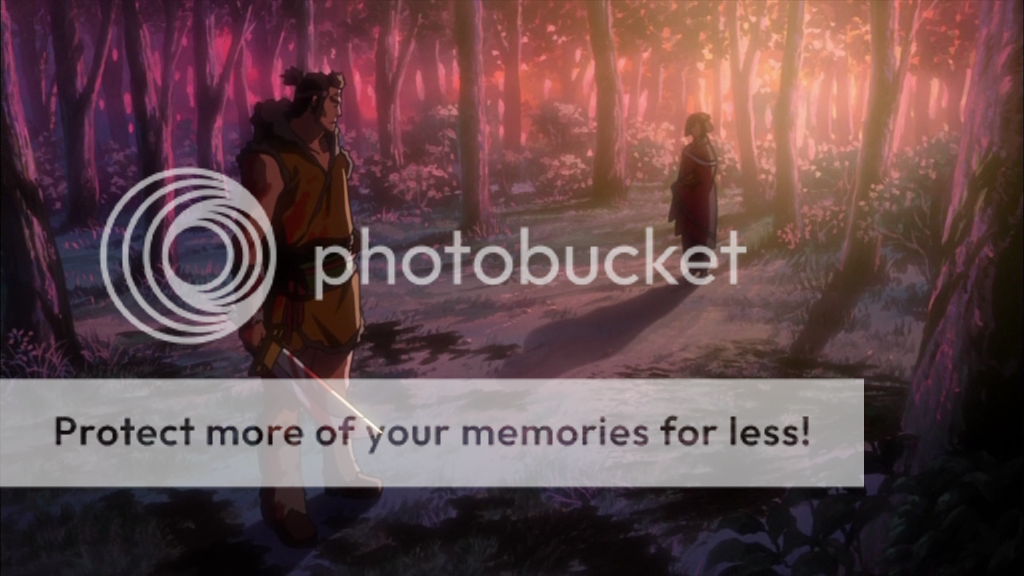
Shigemaru is a bandit who preys on travelers passing by a mountain he considers his own. He has a hut full of women -- his wives -- and feels a certain horrific fascination for cherryblossoms. One day, he meets a beautiful lady and falls in love with her at first sight. After killing her escorts, he takes her back to his hut to become his wife. However, the lady proves to be no ordinary woman as she decides that she can't live with all of Shigemaru's former wives and asks him to kill them.

In the Forest, Under Cherries in Full Bloom
EPISODE 06: Chapter 2
More Screencaps from Aoi Bungaku 06

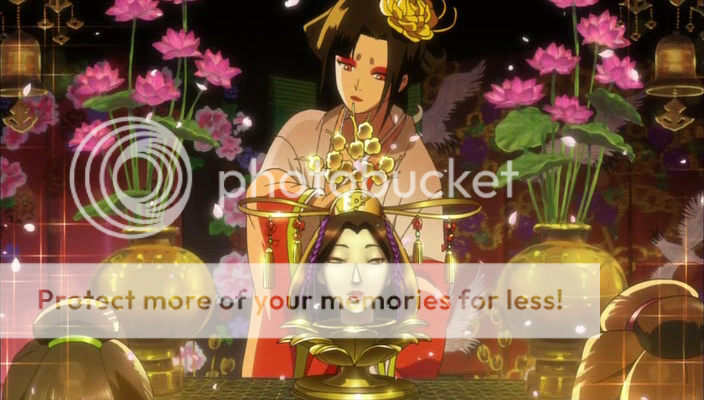
Shigemaru and his wife move to town and try to make a life there. But Shigemaru quickly realizes that he knows nothing about town life and townspeople. His wife demands that he give her some form of entertainment by bringing her back trinkets that belong to the townspeople. So Shigemaru does what he does best and goes around from house to house, stealing things and killing people. Along with the trinkets, he brings back to his wife the decapitated heads of his victims, which his wife plays with like they were dolls. Soon, Shigemaru grows dissatisfied and decides that he wants to go back to the mountain even if his wife won't come with him.

COMMENTS:

This is...a love story? If it is, then it's very strange. And even if it wasn't a love story, it's still a very strange story.

Sakura no Mori no Mankai no Shita
("In the Forest, Under Cherries in Full Bloom") is a novel by Ango Sakaguchi. Roughly, it's about a high-maintenance girl meeting a rustic, getting involved, and the thing ends. In this case, in a most tragic, horrifying, nonsensical way possible.

What is the point, you ask? The point is, there is no point. The essence of In the Forest, Under Cherries in Full Bloom is its structure. It's supposed to be a story within a story sort of thing. Think Shakespear's The Taming of the Shrew, where the story within the story -- i.e. Kate's story -- takes precedence over the original -- i.e. the drunkard who was tricked into thinking he was the king -- until the latter is all but forgotten.

In this case, however, the anime emphasizes the love story between Shigemaru and the lady when it should have focused more on the play that the lady was making with the decapitated heads. That's why you don't see the structure. And that's why the arc doesn't make a lot of sense.

The play is the real story; Shigemaru and his lady are just an excuse to tell said story, which story is in turn just an excuse to bring out the visuals. Because the visuals are what In the Forest, Under Cherries in Full Bloom is really about and boy, what visuals.

Character designs for this arc is Kubo Tite, whom most people probably heard of, thanks to his very popular shounen series, Bleach. Not only that, I think Kubo-sensei is also the mind behind the anachronisms (ipods and camera phones in 12th Century Japan) that abound in this 2-episode arc.

The comedic moments are flat-out hilarious and serve as respite from an otherwise gruesome, disturbing tale. Make no mistake, the tale is gruesome and disturbing and the humor doesn't really balance it all out but it puts the little light of sanity on so much insanity. This is essential as it sets the arc apart from No Longer Human. Even the colors are different. Where No Longer Human was all about dark hues and earth tones, In the Forest, Under Cherries in Full Bloom spreads out in an explosion of colors -- pink, purple, orange, yellow -- all the bright and crazy colors you can think of.

And for the first time, we hear the series' OP theme. I don't know what it's called and who performs it but it's another anachronism -- funk jazz in the 12th Century. Whatever, I love it and want to know its title.

Friday, November 13, 2009

Aoi Bungaku - No Longer Human 03-04

Yuozo tries to live "more like a human" but the nightmare of that one night on the cliff and his own guilty, self-loathing id continue to haunt him. Soon he finds himself to alcohol and women for both redemption and salvation.
No Longer Human
EPISODE 03: Society

Youzo is now living with an older woman and her daughter and seems content for a while. However, his guilt over Mayumi's death keeps haunting him and he develops an obsessive-compulsive habit of washing his hands. With the help of the woman, he is soon able to publish his first manga. This enables Horiki to trace his whereabouts. Horiki tells him about his father's deteriorating health and how society expects Youzo to go back home. Youzo stands firm on his resolve to make a living through his art but Horiki's visit disturbs the little state of equilibrium that his life has reached. Youzo begins wandering the city at night, visiting bars and brothels until one night he collapses in the middle of the street in a drunken stupor. He is discovered by a young woman whom he later asks to save him.

No Longer Human
EPISODE 04: New World

Horiki discovers where Youzo lives and pays him a visit. Youzo, now married to Yoshiki (the young woman from the previous episode), seems happy as he enjoys married life and relative success as a mangaka. The two friends catch up and then Horiki tells him the real purpose of his visit: Youzo's father is dead. As Youzo reacts violently to the news, Horiki rushes down to get some help, only to unwittingly stumble upon Yoshiki having sex with Youzo's publisher. It turns out that Yoshiki has been selling her body in order to get Youzo's works published. That evening, an unstable Youzo attempts suicide but fails. He wakes up in a hospital and overhears his father's servant talking demeaning things about him. Yoshiki and his prostitute friend defend him but Youzo does not stay long enough to hear. He eventually finds himself at the medicine shop he and Mayumi visited years ago. A woman's voice says that she's been waiting for him. Youzo apparently commits suicide again and finally succeeds. The scene closes with him sitting face to face with his id.

COMMENTS:

And that ends the first phase of Aoi Bungaku.

No Longer Human
truly lives up to its title. The bad things happening to Youzo seemed never to let up and only in his final hour is he able to find some measure of peace. Or at least, I like to think it's peace. I'm an optimist. *sweatdrop*

Horiki seems to be the catalyst in driving Youzo to self-destruction. His visits never did Youzo any good although I have to say that he seemed well-meaning in the last two episodes. Horiki's development from a mercenary opportunist to a volunteer soldier strikes me as a bit of a stretch but I think the anime has to contend with the time limit as well as a lot of other factors. Even so, I must say this is not a shoddy adaptation.

Production value is consistent for the entire arc. Art style remains Kurozuka while Youzo's character design looks more and more like Light Yamagami (Death Note). After the third watch, I began to notice the BGM in the background and love the soft, haunting instrumentals. I really like Sakai Masato's voice for Youzo. His voice has that detached air and upperclass accent (or at least, what I imagine to be Japanese upperclass accent) that really fits Youzo's character. By contrast, Sakai sounds ill-fit to voice the main character (a forest ruffian) in the second arc of the series, In the Forest, Under Cherries in Full Bloom.

But all in all, I think Madhouse does it again. Based solely on the No Longer Human arc, Aoi Bungaku looks all set to becoming a masterpiece in the making. Now, I can't wait to look at the rest of what this series has to offer.

Sunday, October 25, 2009

First Impressions: Aoi Bungaku - No Longer Human 1-2

I wasn't about to blog this series. While I was making my shortlist for this season, I noticed Aoi Bungaku, of course, but without any idea what it's really about, I dismissed it, thinking I'd be better off with the three series I picked up for this season. But then, for some reason, the show kept popping up and when I finally read what it's all about, I realized that it's an adaptation of six literary Japanese modern classics, which include, among others, Kokoro by Natsume Soseki. And with that as the final draw, I plunged in and so far, what a ride!
No Longer Human
EPISODE 01: Kamakura Double Suicide
ED: We Say Hello (Manami) [YouTube]

Youzo, a well-off but lonely young man on the run from the Tokyo Police for being a member of the Social Movement, meets a bar hostess, Mayumi (real name Tsuneko) who helps him escape from his pursuers. Mayumi's husband has disappeared and she spends most of her free time trying to look for him in vain. After meeting Youzo, she takes him under her care and the two of them plunge into an intimate relationship, the kind that only two people who share the same intense feelings alienation from the world can have, somehow ending up in a decision to commit suicide together. But only Mayumi dies while Youzo survives to relive the horror of the incident for the rest of his life.

No Longer Human
EPISODE 02: Monster

Youzo's suicide attempt makes it to the news. Worried that the incident would tarnish the family reputation, his father orders Youzo back home and to stay put no matter what. Meanwhile, a woman who works for a newspaper hears about the incident but refuses an assignment to get Youzo's interview. Her life parallels Mayumi's in that she has no husband and has only a daughter to go home to. Confined in his room, Youzo relives his childhood as the only son of a wealthy family, living with his emotionally distant father and the women who always seem to favor him. He begins to have hallucinations of a dark entity which he believes to be his true self as well as visions of Mayumi, whom people are saying he murdered. Youzo eventually runs away but with no one to help him, he has no prospects. The woman from earlier finds him and offers him her home.
COMMENTS:

Ningen Shikakku (lit. "No Longer Human") is a novel written by Osamu Dazai. It's the second best-selling novel in Japan, next only to Natsume Soseki's Kokoro. Prior to this anime, I've never heard of the work, mainly because I have read only one or two works that can be considered Japanese literary classics -- Natsume Soseki's Kokoro and Bocchan.

Based on my readings on Osamu Dazai (Wikipedia), the novel appears to be autobiographical. Both Youzo and the author (real name Tsushima Shuji) grow up in a wealthy family, both get involved in radical political parties as young men, and both attempt double suicide with a Kamakura woman whom they barely know. With its focus on suicide, the psychological motivation behind it, and the emotional consequences, this story is dark. Therefore, it's only right that Madhouse takes the helm of this bound-to-be animation classic.

Stylistically, Aoi Bungaku bears strong resemblance to Kurozuka with its employment of sparse, nearly colorless, noise-rich landscapes and sudden explosions of neon to represent the character's subconscious. The atmosphere, however, is a lot closer to Mouryou no Hakko, with both series' first episodes showing character suicide as the catalyst of the plot, while the character designs look like they're lifted right from the pages of Death Note and with good reason as both series have Takeshi Obata in the designing board. One might also say that the simplistic narrative is similar to Casshern Sins.

The voice cast includes the uber-talented and ubiquitous Paku Romi (Mayumi/Tsuneko), who incidentally also voices Kuromitsu from Kurozuka, Sakai Masato, Mizuki Nana and Noto Mamiko (whom I just know will voice the naive woman). On the directing board for the "No Longer Human" arc (episodes 1-4) is Asaka Morio, the same man behind NANA and Gunslinger Girl, so there's no worries in that area.

Music-wise, Aoi Bungaku is contemplative and surreal like an extended meditation. There are some jazz pieces as well, which is reflective of the story's setting. The ending theme is a nice jazzy, down-tempo vocal number with Engrish lyrics. I don't know who sings it and ANN doesn't seem to have any info on that but it's a nice, if a bit forgettable, song.

Aoi Bungaku is the only dark series I'm watching this season and so far it fulfills all my needs from the genre. Currently, there are only two groups subbing the series, INP and the Suimasen-Nekomimi-Commie (SNC) collaboration. INP releases episodes faster but the quality is low. I'm still downloading the SNC version. The filesize is in matroska format and larger so I guess I can safely presume the quality will be good.

MORE INFO:

OFFICIAL (JPN)
Aoi Bungaku @ Anime News Network